
✅ Communications is aiming for strategy, but needs to make the case for value
Communications leaders expect to shape strategy, but most are not equipped to do so. The real issue is whether the function can prove its value in terms the business understands.
Zeno Group’s Clarity 2030 report sets out an ambitious future for public relations practice. Communications is no longer positioned as a support function but as a driver of growth, risk management and organisational strategy.
That ambition is widely shared. According to the study, 72% of practitioners expect their influence to grow by 2030, and yet only 29% feel fully ready for that shift.
This is a community of practice aiming higher than its current capability allows.
The report is based on a global survey of 1,400 practitioners across 10 countries and three regions, along with 30 in-depth interviews with senior leaders.
Communications management and leadership
I’m hosting a series of one-day courses on communication management and leadership, including how the communications function is becoming part of management, and what it means for your work and development in 2026. Please follow this link for the syllabus and availability. We’ve added new dates for May and June to meet demand.
The narrative is spot on, but the diagnosis is incomplete
The report sets out five signals shaping the future: rising influence with limited readiness, expectations to lead on AI without adequate tools, changing information discovery and rising credibility demands, creative thinking and judgment as differentiators, and a growing risk of talent exit.
Regular readers will recognise this as the narrative of communications moving upstream from message and media management to strategic leadership. The report is right about that direction of travel, but it dodges a more uncomfortable issue.
Zeno’s report identifies creative thinking and judgment as the top capabilities for future leaders. In a more complex, AI-shaped information environment, there is no doubt that those qualities will matter, but creativity expressed through media metrics alone will not secure strategic influence.
What earns a seat at the table is different:
Alignment with commercial priorities,
Contribution to organisational relationships,
and evidence of value creation or cost avoidance.
In other words, communications needs to speak the language of management, not just the language of media.
Where the report adds value
It’s easy to dismiss agency-led research as promotion, but there is much in the Zeno report that is useful. It rightly highlights structural shifts related to AI, the upstream movement of communications into management decision-making, and the way expectations are outrunning capability.
The finding that 77% of practitioners believe entirely new skill sets will be required by 2030, while fewer than half currently have access to approved AI tools, points to a systemic problem that individual development cannot solve.
The five leadership actions the report proposes - on technology investment, consistency, creativity, insight and role design - are sensible, but they miss the central challenge in my view.
The communications functions that achieve genuine strategic recognition do one thing consistently well: they align with how the organisation works, plans and measures success.
What this means for practice
Three shifts are required if communications is serious about stepping into a strategic role.
Reframe measurement
What senior leaders need is evidence of behavioural and organisational impact: changes in stakeholder relationships, risk avoided, decisions informed. That is what strategic contribution looks like.Adopt the language of the business
Communications activity needs to be translated into value creation, risk mitigation or cost efficiency. These are the terms in which organisational decisions get made.Build genuine organisational alignment
Planning and reporting need to make sense to a CFO or a board audit committee, not just to a communications peer group. That discipline, more than any tool or technique, is what closes the gap between ambition and recognition.
Clarity 2030 is a useful map of where the communications discipline thinks it is heading. The tools will keep improving, and the job titles will keep getting more senior, but until communications learns to demonstrate its value in terms that the business recognises, its influence will remain a promise rather than a reality.
Have a great week ahead.
Socially Mobile is recruiting students for fully-funded places for next cohort
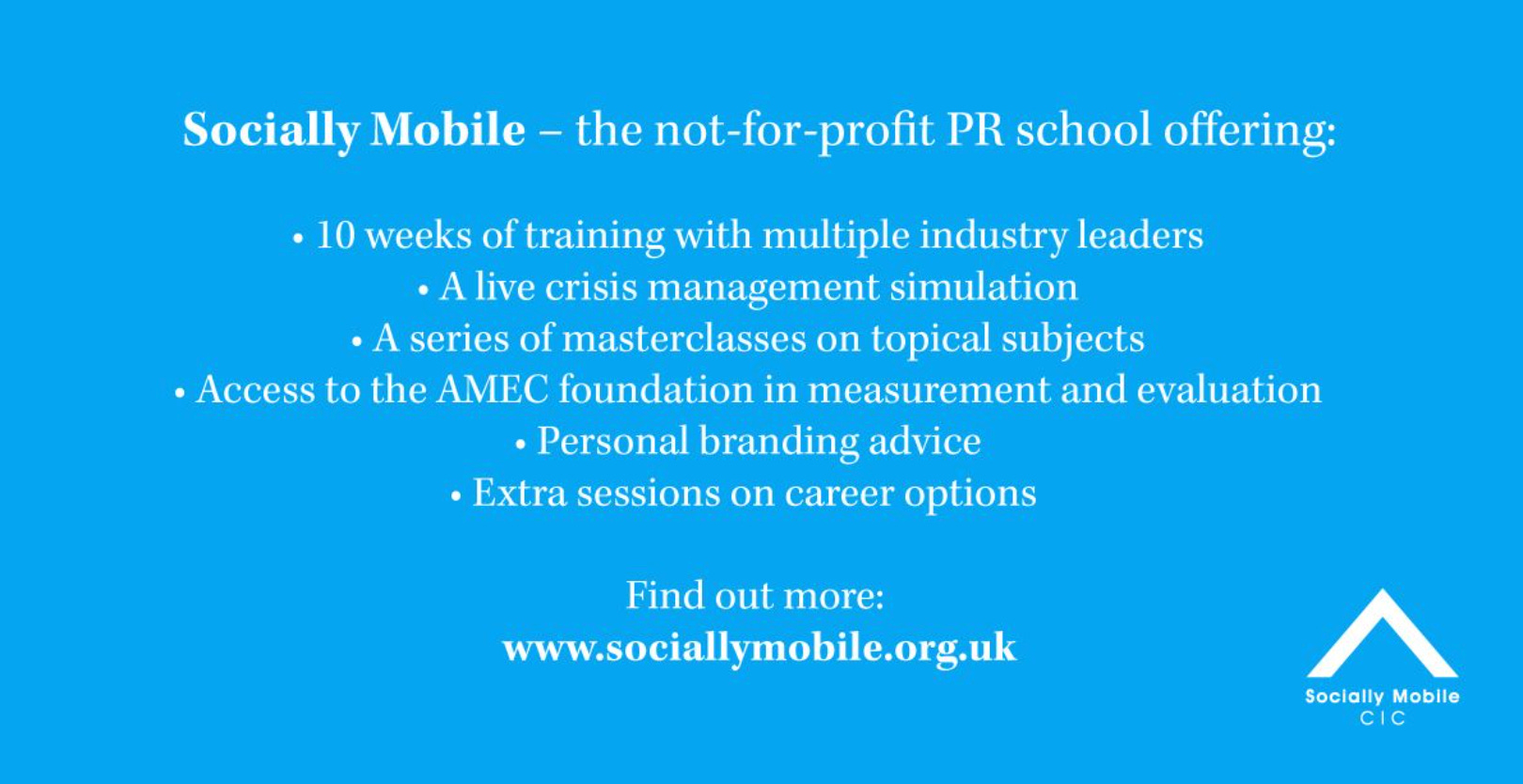
Socially Mobile is accepting applications for its ten-week online programme. Applications for our fourteenth cohort are open to practitioners with four or more years of experience until 10 April 2026.
The programme is designed to support practitioners moving into a management role, with modules on planning, measurement, finance, creativity and crisis management.
Fully-funded places are available for individuals from lower socio-economic backgrounds and under-represented groups, including minority ethnic practitioners, the LGBTQ+ community, women returners and those with disabilities.
Join the biggest industry conversation about AI and the future of public relations in London in June
100 tickets sold. Less than 90 days to go. The AI for Public Relations conference is coming to London on 18 June, and the response so far has been extraordinary.
The vision is to build a community of practice - a room full of people serious about working through the issues that will define the next decade of communications.
We’ll be exploring the future of careers and governance, efficiency and effectiveness, tools and technology sovereignty, AI as a stakeholder, the future of earned media, and end-to-end workflow. The questions every communicator is already grappling with.
My co-editor Ben Verinder and the team at Cravenhill Publishing have brought together the authors who contributed to AI for Public Relations: A How-To Guide for Implementation and Management alongside many of the organisations featured in the book, and special guests.
First release tickets close on 31 March. If you want to be in the room for what I think will be the most important corporate communications and public relations event of the year, now is the time to buy a ticket

The Wadds Inc. newsletter is trusted by more than 5,000 practitioners seeking clarity on issues such as sensemaking, governance, organisation alignment and capability from a management and communication perspective. We take a slower, critical perspective to distilling news, research and industry developments into actionable briefings to help you at work.
Knowing how to articulate PR achievements and align it to the commercial objectives of the business is something I’ve realised is very important. Especially working for a financial services firm where the visibility can lead to increased deal pipeline or/and LP interest.
What you said about comms role eventually becoming more about growth than support function is very exciting and I hope it happens sooner rather than later.